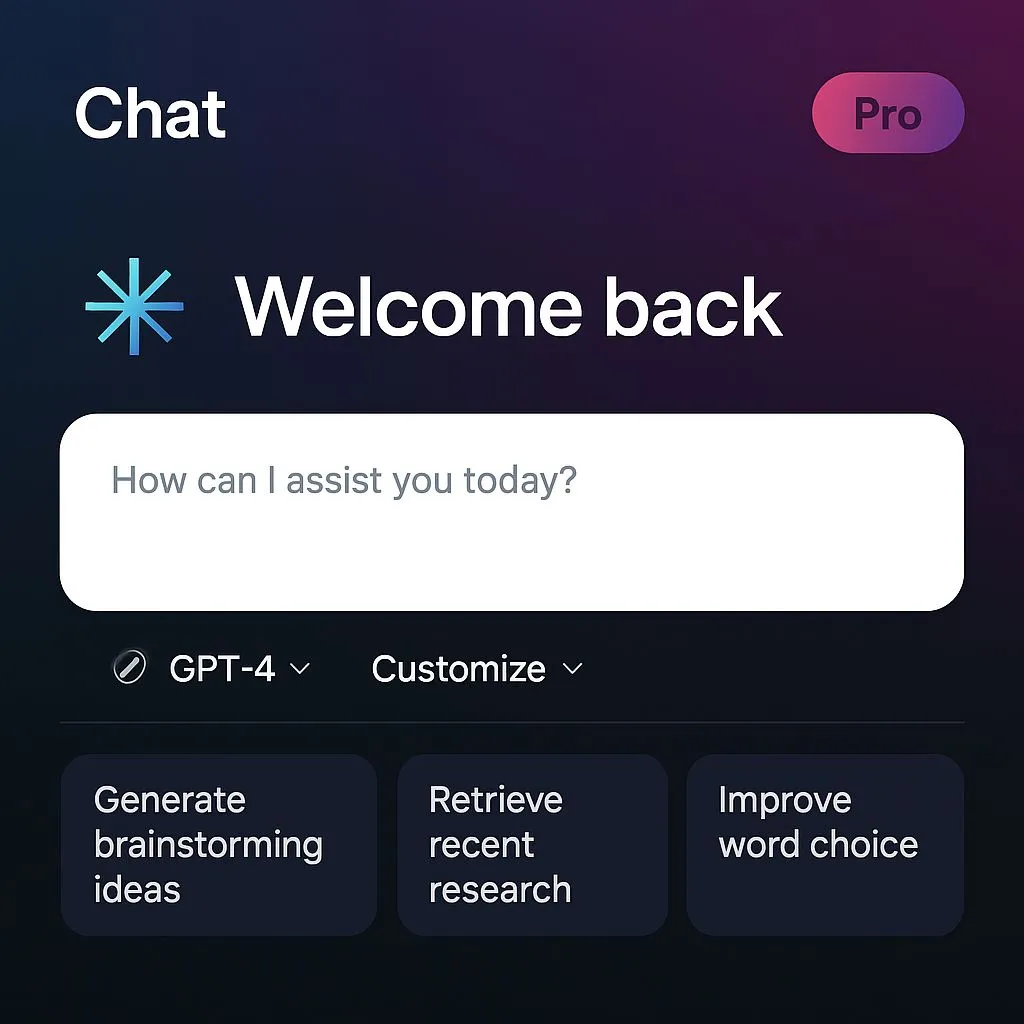
The visual interface of products has changed dramatically in the AI era - but most of us keep building as if nothing happened.
Machine translation from the original post. Not reviewed by a human translator. Historical claims may no longer be current.
The visual interface of products has changed dramatically in the AI era - but most of us keep building as if nothing happened.
I want to bring to your awareness something that seems natural, almost transparent, but critical - something that needs a spotlight, so that in the next interface you develop it will be there:
A new component has joined our lives and taken over a significant part of the screen - the chat. As dramatic as this event is for the world of interface builders, that's how natural and smooth it feels to us, the users.
The chat has become a visual marker of how much AI is in a system. When a user meets your system they immediately notice this:
- If there's a floating circle in the corner that opens a chat, the user understands there's a support bot here.
- If they meet a landing page with a big chat rectangle, and inside the system a quarter of the screen is dedicated to chat, the user understands they're entering an AI First product.
- And when the whole interface is a chat - the user understands this is an AI Chat product, like ChatGPT and its ilk.
(At the same time, we still see UX scams. A chat on the home page that has no internal continuity. This happens mainly at companies that haven't yet internalized the purpose of the new interface. You can see it in products like Airtable or Bubble - where the chat only kicks off an initial process, but in practice the fixes and settings are done manually in the traditional interface)
The challenge of building an interface that knows how to live in the new world also meets the flag bearers of the technology: Claude for example, which presents a chat interface with MCP buttons for automatic actions.
On the one hand, that's a statement of advanced automation. On the other hand, the feeling is of handing full control to the system - processes that run in the background without explanation, transparency or ability to monitor.
This is a clear illustration of the problem interfaces are still trying to solve: how to allow autonomy without giving up the sense of control?
I recently watched a talk by Andrej Karpathy, one of the founders of OpenAI (the one who coined the term Vibe coding).
He described successful interfaces as ones that allow movement along the "autonomy slider" - from small tasks the user triggers themselves, to fully autonomous actions performed in the background.
He said: "You are the one controlling the autonomy slider, and depending on the complexity of the task you decide how much control you're willing to give up in favor of the system."
Take the code development interface Cursor as an example demonstrating an autonomy slider from basic to full automation:
- Autocomplete as you type
- Changing a block of code
- Changing a whole file
- An agent that makes changes across the entire repo
As long as the user holds the wheel, even when the AI is driving - the sense of control and trust is preserved.
You can also look at it through a condition - the complexity of the processes the AI performs should be conditional on the level of confidence you give the user:
how much they can follow, understand, and verify what happened and why.
By the way, there's another stream developing, the invisible AI - No-UI AI interfaces.
Systems in which the intelligence doesn't appear as a chat or bot, but simply blends into the existing flow: Gmail completing sentences. Google Photos recognizing and classifying, or Notion integrating AI capabilities within the editing itself without adding a new interface layer.
It's a different approach - quiet, precise, almost invisible.
In an era when language models keep improving, it's important for interface developers to know the behavior and nuances this new world brings, because a right interface that waits for a better model will only improve, and a bad interface - even GPT-7 won't save it.