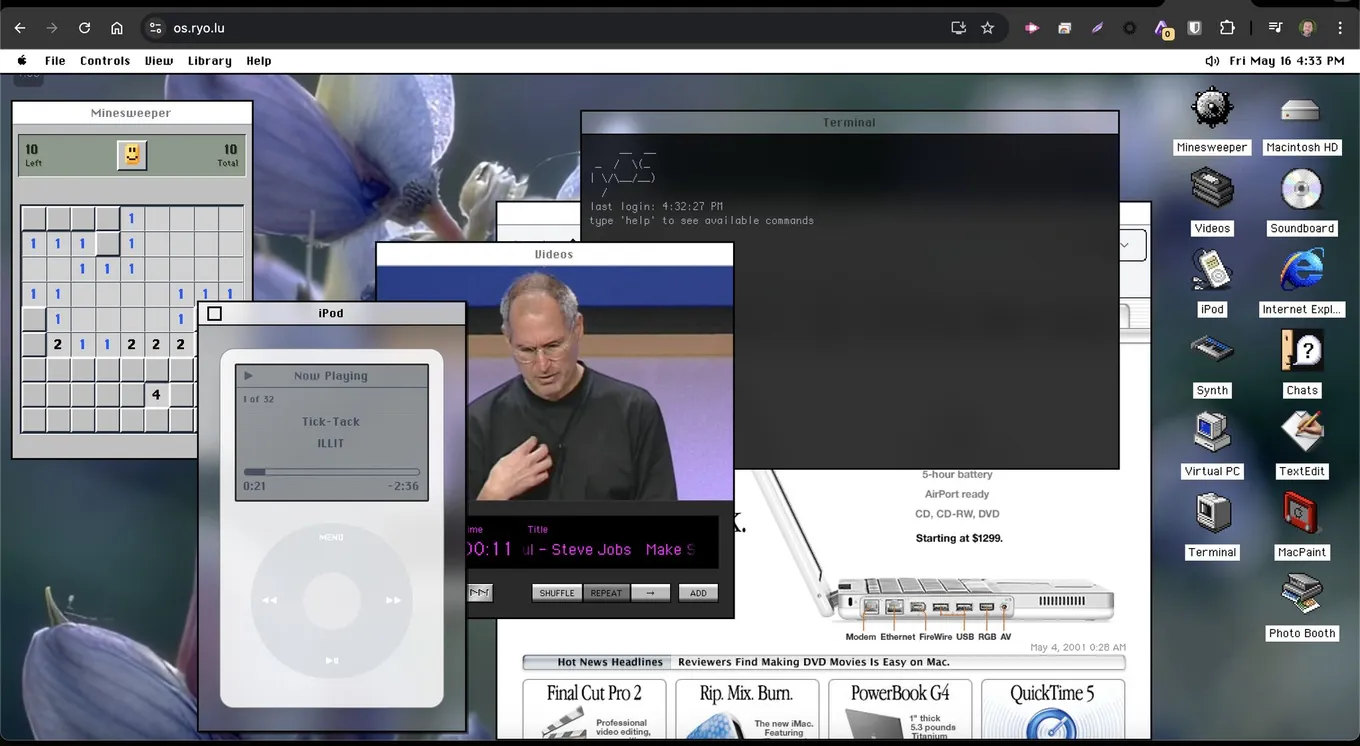
It's crazy that this operating system was built and is run by AI inside our browser!
ryOS is a kind of fake "operating system" that runs in the browser, and it looks and behaves like a computer from the 90s - with old icons, music in an iPod, drawing in MacPaint, pop-up windows and a terminal.
But all of this is actually just a wrapper for the real thing happening behind the scenes:
This entire system is powered by AI - artificial intelligence that understands what you're doing, can help you with code, edit files, send commands, and more.
It's actually a demonstration of what the future of browsers and operating systems could look like, when AI is not just a "chatbot", but an integral part of the system.
The creator of this built almost everything himself, and used an approach he calls "vibe-coded" - that is, not according to an orderly spec, but according to what feels right: design, sounds, user experience - everything was built to evoke a sense of wonder and nostalgia, but also to reflect a new idea.
It's not just an open source project. It's a small, living, breathing world, built almost entirely by one person - Ryo Lu, head of design at Cursor.ai.
In the interface that looks remarkably real you can find:
▪️ Finder with a virtual file system.
▪️ MacPaint for drawing in 80s style.
▪️ iPod that plays YouTube playlists with a real scroll wheel.
▪️ Synth with MIDI support.
▪️ Terminal with an AI assistant named Ryo, that can edit files, run commands and talk with you.
▪️ Internet Explorer with Wayback Machine integration.
And plenty of other small apps, all with retro aesthetics, sound effects, and more...
But beyond the nostalgia, it's a fascinating experiment:
What does a user interface look like when AI is part of the system, not just an add-on? How does it feel to work in an environment where every app can talk to your assistant, understand context, and act accordingly?
It's currently not a commercial product, but a Proof-of-Concept of what browsers and future apps could be. Its code is open and available to everyone on Github.
It's also a reminder: sometimes, to imagine the future, you have to go back to the past.
Feel free to see and play with it yourselves (recommended from a computer): https://os.ryo.lu