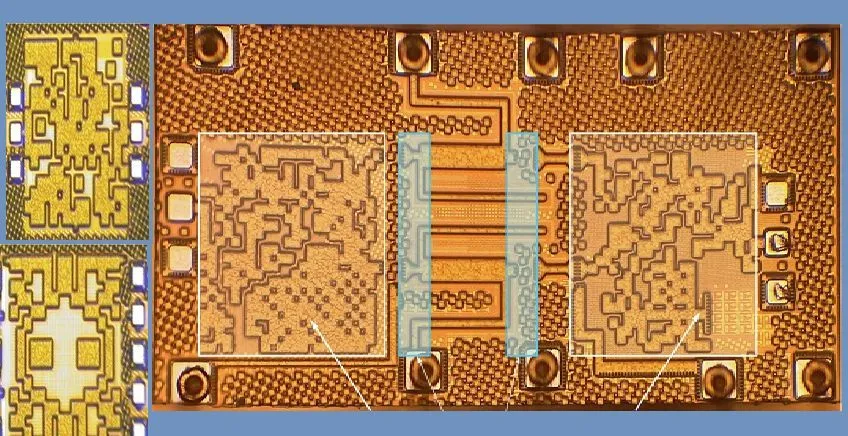
Artificial intelligence managed to design a revolutionary communications chip - that human engineers can't even decipher 🥸 📱
Machine translation from the original post. Not reviewed by a human translator. Historical claims may no longer be current.
Artificial intelligence managed to design a revolutionary communications chip - that human engineers can't even decipher 🥸 📱
Researchers from Princeton University and the Indian Institute of Technology (IIT) presented a surprising breakthrough in the world of engineering design: an artificial intelligence program managed to design 6G communications chips in an especially efficient way (terabytes per second!) using non-intuitive models that humans simply can't decipher. The result is chips showing unprecedented performance, with the potential to revolutionize the industry.
The technology is based on an "Inverse Design" approach, in which the algorithm starts by defining basic parameters such as frequency and power, and then builds a custom solution that does not take into account the limits of human thinking. In initial tests, the chips' performance was about 30% higher compared to traditional design methods.
According to Professor Kaushik Sengupta, who led the research, "The new designs are amazing not only in their performance, but also in that they completely depart from engineering intuition. These are results that engineers not only didn't think of, but are unable to understand how they work."
What does it mean for the industry?
Until now, chip design was a long and complex process that required teams of experts and meticulous manual work. With the use of artificial intelligence, development time can be cut from days to hours, freeing engineers to focus on other complex tasks. In addition, chips produced with the new process not only save time, but also show unprecedented performance in energy utilization and efficiency.
The technological breakthrough of artificial intelligence brings with it not only innovative solutions but also quite a few questions and challenges. One prominent issue is the fact that the chips designed by the AI are so complex and non-intuitive that the engineers themselves have difficulty understanding how they work. In a world where transparency is a supreme value, a critical question arises: how can we adopt technologies whose basic principles we don't understand?
In addition, there are significant technical and ethical issues: what will happen if the algorithm makes a mistake in a critical design? How can we make sure such a technology isn't misused? And how can we ensure that the use of these solutions actually serves human interest and doesn't harm it?
Despite the impressive capabilities of artificial intelligence, the biggest challenge lies in us – humans. While the algorithm manages to produce solutions at lightning speed and sometimes even more efficiently than human engineers, the responsibility to examine the results and decide whether they meet expectations or, heaven forbid, mislead, remains in our hands. We serve as the gatekeepers, and thereby also as the bottleneck of these development processes.
This task is not only technical - it is critical and acute for us. If we lose the ability to judge the work of artificial intelligence in an informed way, we may find ourselves in a situation where efficient solutions become dangerous just because we didn't understand them deeply.
Therefore, our role is not only to approve the results, but also to make sure they reflect our values and needs as human beings.